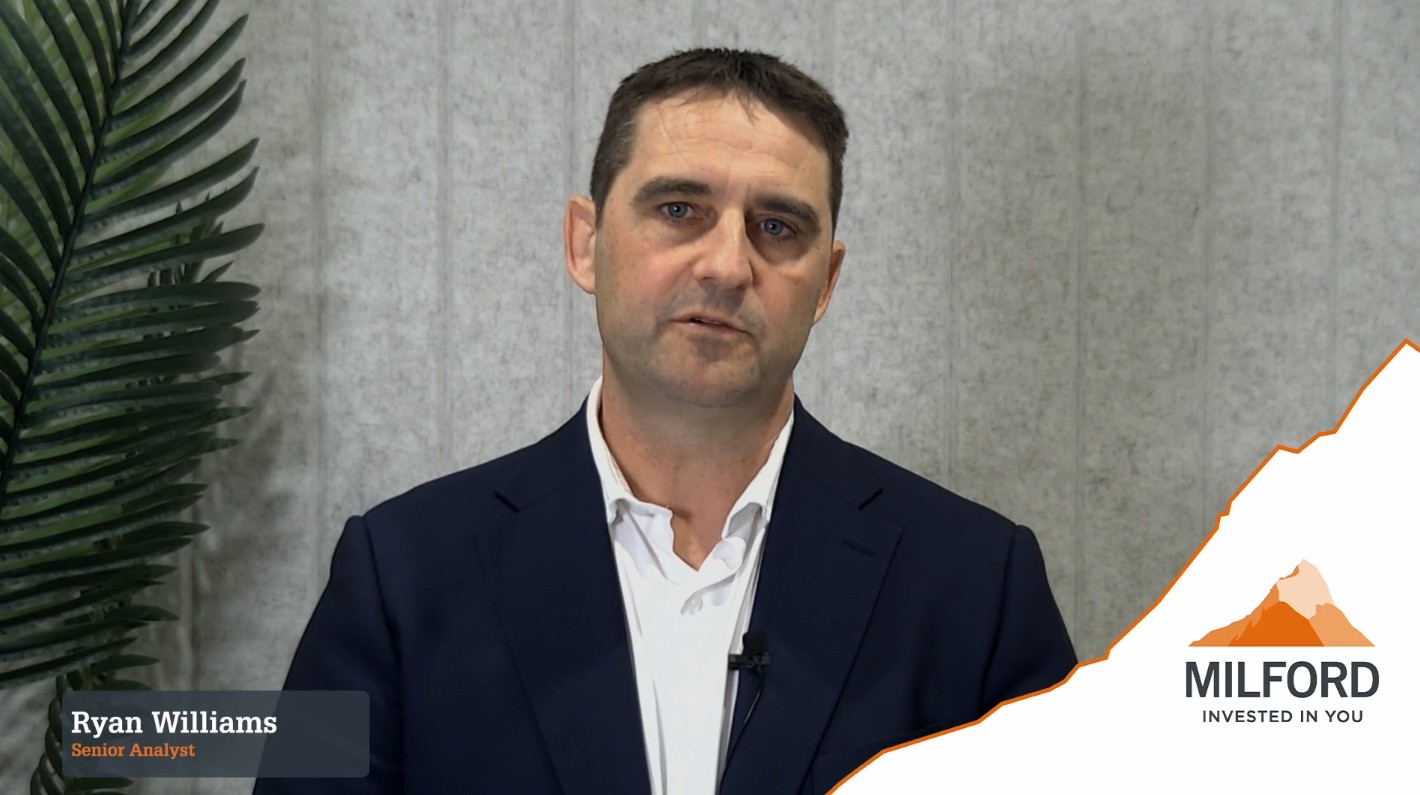

It’s been a whirlwind start to the year, with geopolitical uncertainty and myriad market moves dominating the media. Amidst all of this, investors are increasingly expecting global growth to improve in 2026. Milford Portfolio Manager Mark Riggall talks with Ryan Bridge about the themes expected to influence the market as the year progresses.
Click here to download the MP3 file or listen to the podcast on your favourite platform:
Bridge talks Business: 20 January 2026
Episode Transcript
Ryan Bridge
Kia ora and welcome to Bridge talks Business with Milford, episode 59. It is great to be back with you for 2026. On today’s show, we’re looking at why shares in Europe, the UK, and Japan are blitzing American stocks – outperforming the Americans. It’s a question we should all care about because 60% of our KiwiSaver balances are invested offshore, mostly on Wall Street, and it comes despite renewed confidence in the strength of the US economy and consumer. Mark Riggall from Milford is here to kick off the new season.
First, here’s your top five business bits from the last seven days.
1. 2026 kicked off with a hiss and a roar. Markets so far, though, are relatively chill about Venezuela and Greenland, although over the weekend, investors started to take some notice with weakness in US assets, including shares, bonds, and the dollar.
2. Outside of geopolitics, evidence is building that US economic growth is on a firmer footing as effects of Trump’s fiscal plans start to take effect. Tax refunds and other measures will start to boost household earnings there and consumer demand.
3. Domestic US policy announcements are coming thick and fast, and they’re aimed at improving affordability for your average voter, including proposed caps on credit card interest rates as well as changes to lower the cost of mortgages.
4. Attacks on Fed Chair Jerome Powell have escalated with a Department of Justice subpoena. This is undermining institutions. Investors are flocking to the safety of gold and other precious metals, some of which have also increased demand from industrial use.
5. And finally, back here in New Zealand, surveys have perked up from the business community, optimistic about the outlook with lower interest rates starting to feed through to those households. Last month saw the dollar finally start to arrest some of the slide that we’ve seen against other currencies.
Let’s crack into it. Mark Riggall from Milford is our man of the moment because Trump hasn’t wasted any time this year getting his policy out the door, so we won’t waste any time either. Mark is with us. Just a reminder, this segment as always is informational only and should not be considered financial advice. Mark, welcome back. Happy New Year.
Mark Riggall
Happy New Year. Good to see you.
Ryan Bridge
We’ve got lots to talk about. Normally at this time, we’d be sort of easing into the year, but we have a plethora of news coming at us. So let’s get straight into it and talk about markets. The US is being outperformed in terms of stocks at the moment by the likes of Japan, the UK, and Europe. What’s happening there? Is there something wrong with America? Are the valuations maxed out? What’s going on?
Mark Riggall
Yeah, interesting that you mentioned that, because it’s a little-known fact that actually last year, the US stock market was outperformed by other stock markets, such as the UK, Europe, and Japan. So what we’re seeing at the beginning of this year is actually a continuation of that. It’s been a very strong start of the year for places like the UK, Europe, Japan stocks over the US, which have been kind of middling or flat.
Part of that is just the composition of the index. The US is obviously dominated by very large technology companies. What we’re seeing at the moment is actually optimism around the economic outlook, which means that a broader set of companies can start to perform rather than just a very narrow set of technology companies that dominate the US market. We’re seeing that. There’s some idiosyncratic factors relating to places like Europe and Japan. Like in Europe, Germany is doing fiscal stimulus, which is supposedly kicking off now, which should support spending and support the economy and support the stock market. Similarly, in Japan, you’ve got a new prime minister over there who is campaigning on a platform of fiscal stimulus, which again should be supportive of the stock market, alongside some other factors in Japan, which are supporting the market there, such as a lower currency. And so there are a few things going on, but by and large what we’re seeing here is global markets outperforming the US.
Ryan Bridge
And so in those specific examples, the markets are saying there’s stimulus coming, therefore these companies should perform pretty well, the economy should be doing pretty well and be holding up quite robustly.
Mark Riggall
Yes, that’s right.
Ryan Bridge
So, what about the technology? End of last year, we were talking about the AI boom and is there going to be a bubble. What’s happened so far this year with technology stocks? So where are investors looking?
Mark Riggall
This story never gets kind of cold if you like. It’s like a freight train that’s coming. Last year we talked a lot about “picks and shovels” – the semiconductors. If we’re going to build this AI infrastructure, then we’re going to need semiconductors, lots of them, lots of data centres. And so the performance for a long time – for the last 18 months to two years – has been about these companies that deliver semiconductors, and have performed very well. And obviously the poster child for that is NVIDIA, the largest company in the world now.
But now the story is moving on and it’s about okay well, when we build all this infrastructure, what can this technology do for everyday companies? There is now an optimism that this technology can be quite useful in making companies more efficient, reducing bureaucracy, and implementing this technology to deliver better earnings with less expenses, effectively. So, that again supports the “broadening out” thesis, because you don’t need to be a technology company to benefit from the use of technology in delivering you better earnings outcomes. So, you’re seeing a little bit of that start to play through.
One key area – because there’s obviously winners and losers with that – so one key area of volatility we’ve seen at the start of this year already, is software stocks have been hit quite hard because Anthropic delivered their latest model, which looks like it can deliver lots of things that software already does for you. So, software-as-a-service companies have been hit pretty hard on the back of that. So there are some winners and losers, but that broadening out is supported by companies being able to use technology.
Ryan Bridge
And how do you pick the winners? How do you know which companies would benefit most from AI and therefore whose stocks might rise?
Mark Riggall
That’s a tricky question, but you can look at things like how bureaucratic is a company? Does a company have lots of low-level, entry-level workers who are doing some very basic tasks that could be automated? They obviously will be ripe for using technology.
Ryan Bridge
Now, let’s talk Greenland and Venezuela, and to a lesser extent, Iran. How are markets reacting, or have they reacted yet to this?
Mark Riggall
Markets are very sanguine on the whole Venezuela situation and have been pretty sanguine on Iran. Greenland’s a little bit of a different issue. I think what we’re seeing here is the US trying to [place] national security over critical minerals and supply of hydrocarbons oil. Venezuela is a big supplier of oil. The US doesn’t necessarily need that oil because it produces its own oil already, but Venezuela has been supplying oil to China, so actually taking control of Venezuela limits the supply of oil to places like China. So it’s about national security issues.
Similarly for Iran, the US hasn’t been involved there to date, but there’s lots of protests, disruptions and demonstrations there. The US has made noises about intervening. I wouldn’t be surprised to see that happen as well, based on that similar premise that they don’t need Iranian oil for the US, but it will prevent Iranian oil finding its way to China. Where Greenland is a bit different is obviously there’s a spat between the US’s ostensible allies in Europe. A lot of these European countries have stood shoulder to shoulder with the US only many fronts. So, for Trump to go and impose tariffs on his friends in Europe because of Greenland, does seem to be a kind of ratcheting up of the tensions. What we’ve got this week is Davos in Europe this week where Trump is attending, so I think we’ve got to expect a fair bit of headlines and comments around what’s going on in Greenland.
Ryan Bridge
How serious do you think he is on Greenland?
Mark Riggall
Hard to know. What we know with Trump is that he goes very far in one direction and then walks it back.
Ryan Bridge
Which is why markets perhaps aren’t reacting in the way that they might have a year ago.
Mark Riggall
Yes, exactly. We’re used to this kind of procedure – the process he goes through.
Ryan Bridge
The threats.
Mark Riggall
And of course, it’s a US public holiday on Monday this week – or was – so the US markets haven’t actually opened at this time of speaking right now. We’ll see if he walks back any of those measures by the market open tonight.
Ryan Bridge
There is a bunch of stuff Trump’s been doing that we don’t actually hear a lot about in New Zealand media – stuff like interest rates on credit cards and making mortgages cheaper for people in the States. This affordability thing. He wants to get affordability back on the agenda because he’s got midterms to worry about. Cost of living is the big issue. How are all of those measures affecting markets? Or are markets reacting to that?
Mark Riggall
At the beginning of this year, Trump has come out swinging with regards to policies. The number one issue for voters is affordability, and there’s a midterm election at the end of this year in the US, where the Republicans – Trump’s party – could lose a lot of seats. And so Trump is doing lots of policy measures. These include, like you say, caps on credit card interest. There’s no legal route for him to do that other than moral suasion on the banks – good luck with that – but he’s trying to lower the cost of interest that consumers are feeling.
Oil prices as well, the Venezuela step does help lower the oil price, and the US is a big consumer of gasoline – the consumer is, so that’s another measure. And then the other one is the housing market. So he’s directed agencies to buy mortgage-backed securities aimed at reducing mortgage costs. He’s looking at other measures to reduce mortgage costs to try and get the housing market going again. Because its currently in a bit of a stalemate and going nowhere. So, if he can unlock the housing market and make it more affordable without reducing prices of houses, then he’s taking those measures as well. So, it’s aimed at reducing affordability. It’s unclear about how successful he’ll be, but the direction of travel is clear. And so ultimately what that’s doing is improving demand in the economy. Improving households’ ability to spend because things are more affordable.
Ryan Bridge
And all of that, plus his fiscal stuff, means the American consumer is holding up quite resiliently. There’s sort of positive signs about that.
Mark Riggall
Yeah, we had a big headwind last year because there was a tax on the American consumer in the form of tariffs. So that was a massive headwind last year and that’s now falling away as the tariffs have been passed through. This year we’re going to have a tailwind of fiscal support. That’s why we’re optimistic about the outlook for growth in the US – because of that switch from policy being a headwind to a tailwind.
Ryan Bridge
Finally, this is the juicy stuff. What are your picks for this year? What are the themes that we’ll be seeing? Do we need to manage our expectations around growth in the stock market given the runaway stocks last year? Or will we see that continue?
Mark Riggall
Let’s stand back and look at the ingredients. We think economic growth is going to be reasonably strong this year, not just in the US but around most parts of the world. So, that’s a big tick. And that’s a big supportive thing for an investor. Also, profits on the back of that will be likely strong. Profit growth is going to be good. Again, another big tick. The big “cross” comes in the form of valuations, which are reasonably expensive in share markets. That’s not necessarily an immediate problem, but it’s something that tempers our enthusiasm a little bit.
The big risk is that market-based interest rates start to move higher – so these are bond yields in the US, predominantly. They have been quite muted – they’ve been quite contained – and if they start to move higher, reflecting higher inflation or higher growth, then that could disrupt markets. As usual, there’s lots of uncertainty, and with high valuations, you have to expect a bit more volatility. But the outlook remains reasonable for growth and outlook for the “average” stock rather than just a narrow group of stocks, which we think is a good opportunity set for us.
Ryan Bridge
Brilliant. Mark, good to see you, and we’ll see more of you in 2026.
Mark Riggall
Thanks very much.
Ryan Bridge
That was Mark Riggall from Milford talking about the geopolitical situation around the world, but also what we can expect from stocks going forward into 2026. It is great to be back with you for a new season. Don’t forget you can like, follow, and subscribe us wherever you get your podcasts. In the meantime, don’t forget to invest in yourselves.
Missed previous episode? Don’t worry! Click here to catch up now.