Active Management

We actively manage our clients’ investments with discipline, research and a focus on long-term outcomes.
Investing is a long-term journey. Markets operate through cycles, and they can change quickly. Active management gives Milford the flexibility to make deliberate, research-led decisions based on experience of managing through many market cycles and managing risk, rather than simply accepting the market as it stands.
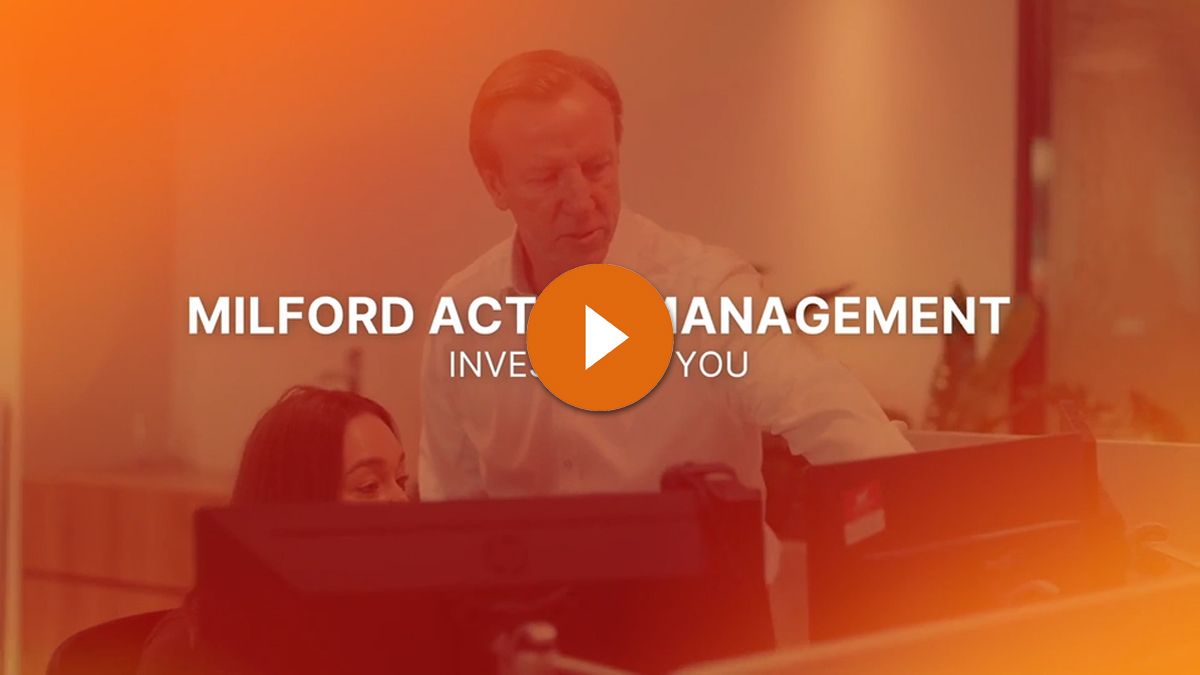
Hear how Milford approaches active management

What is active management?

Active management is an investment approach where experienced professionals decide what to invest in, what to avoid and when to make changes.

Our team of over 40 investment professionals in Auckland and Sydney are constantly researching markets, seeking the best opportunities and applying disciplined risk management practices, to help our clients achieve their long-term investment goals.

Rather than simply following an index and accepting its composition, we take a more active approach. As active managers, we apply a bottom-up process with in-depth research at an individual company level, and pair this with a top-down lens, considering broader factors, including the economy, market positioning, market cycles and the opportunities and risks these factors present. This approach allows us to be selective about where we invest.

Our goal is to seek consistently good, long-term returns, while staying anchored to pricing fundamentals and carefully managing the level of risk each fund is designed to take.

Why active management matters

Economic conditions, interest rates, technology advances, inflation expectations and geopolitical events all influence markets and prices. Markets also don’t always price investments efficiently, some companies may become overvalued, while others are overlooked despite strong potential. Active management considers all of these factors, their influence on company valuations, and then whether to invest in the companies or not.

Our investment philosophy

Our active management philosophy is grounded in disciplined risk management, in-depth research and a focus on long-term outcomes.

As active investors, we use the depth of our team’s experience to look for situations where the market may not yet fully reflect an investment’s value or risk. We test assumptions, look beyond short-term headlines and make deliberate decisions using ongoing assessment and judgement exercised over numerous market cycles.

This means we can:

  • Invest in companies we believe have strong long-term potential
  • Reduce exposure where we think value has been realised, or where risks to valuations appear too high based on our analysis and experience
  • Adjust investments as conditions change
  • Build diversified portfolios aligned to each fund’s objective.

At Milford we take the risk to your money seriously. We invest alongside you too. Over time, we believe managing downside risk can be just as important as identifying investments with strong return potential.

Monthly-Fund-Overview

Understanding our investment process

We use a structured process that combines bottom-up research and top-down analysis. We continually assess both our existing investments, market conditions and future opportunities and risks, with a focus on building value over time.

Bottom-up research

    • Individual company research, including outlook, valuation and long-term potential.
    • Meet with hundreds of companies each year to understand where our clients’ money should, and should not, be invested.
    • Look for opportunities where the potential return is attractive relative to the risks involved.

Top-down analysis

    • Evaluate the economic picture and consider how it may affect sectors, businesses and consumers.
    • Use this broader market view to identify risks, test assumptions and uncover opportunities that may be overlooked.

Risk and investing timeframes – staying focused on long-term objectives

Milford’s funds may look and perform differently from market indices or other managers at different times. These differences are intentional and reflect the objectives of the fund and decisions we make for each fund.

The level of volatility or risk we are willing to take on depends on the objective of the fund. This is why choosing the fund that best suits your goal and time horizon matters. Some funds are managed to meet very near-term objectives, such as the Milford Cash Fund. Others are built for longer-term growth, such as the Milford Aggressive Fund with a minimum 10-year investment timeframe, and others, such as the Milford Active Growth Fund operate with a specific objective through all market conditions over its minimum investment timeframe of seven years.

Funds with longer time horizons generally see greater volatility (movements up and down) than shorter-term funds but also have more opportunity for higher returns. That’s why we believe in active management, risk management and goals-based investing.

Active vs Passive investing

Active and passive investing work in different ways. Passive investing generally follows a market index. Active management allows Milford to look beyond index weightings and assess whether an investment’s price, outlook and potential return justify the risk.

Active investing

    • Investment decisions are made by a team
    • Can move away from expensive assets
    • Can adjust exposure to manage risk
    • Focuses on fund objectives

Passive investing

    • Follows an index or indices
    • Holds assets based on index weightings
    • Moves with markets, both up and down
    • Focuses on matching an index
How Do Compounding Returns help my KiwiSaver?

What does this cost?

As with all actively managed funds, there is a fee for the work involved in researching opportunities, managing risk and making ongoing investment decisions. Milford’s fees may be higher than some lower-cost investment options, however, our focus is on the value created after fees over the term of the fund. That is why we show our returns after fees, so investors can see the true return Milford creates.

What does active management look like in practice?

Milford looks beyond the headlines

Markets can move quickly on headlines, trends or investor sentiment. We look beneath the surface to assess whether an investment’s fundamentals have changed or whether the market has overreacted.

Managing risk when markets become expensive

At times, some sectors or companies may become highly valued after strong performance. When we believe the risks outweigh the potential reward, we can reduce exposure and look for opportunities elsewhere.

Finding opportunities others might miss

We research companies, visit premises and meet with business leaders across New Zealand, Australia and global markets, drawing on our expertise to understand what may drive value.

Thoughtful adjustments as conditions change

While no investment strategy can eliminate risk or guarantee returns, active management allows us to make thoughtful adjustments when we believe it supports fund outcomes, rather than holding investments simply because they are part of an index.

Managing diversification

Rather than concentrating investments in a small number of companies or sectors, we seek to build diversified portfolios that balance opportunity for reward with risk management.

This ongoing decision-making sits at the heart of active management.

Frequently asked questions

Markets do not move in a straight line. Active management gives Milford the flexibility to make deliberate decisions as conditions change, while staying focused on each fund’s objective and recommended investment timeframe.

Every investment decision starts with disciplined research. We assess businesses, industries and economic trends to identify where potential rewards may justify the risks being taken. We also consider whether an opportunity is already reflected in the price.

It depends on your goals, timeframe and tolerance for risk. Active management may suit investors who value professional expertise, ongoing portfolio oversight and the ability to respond as markets change.

A market index is a measurement that tracks the performance of a group of investments, usually shares, bonds, or other securities. It is used as a benchmark to show how a particular market or segment of the market is performing. For example, S&P/NZX 50 Index tracks the performance of the 50 largest New Zealand companies listed.

We invest alongside our clients

At Milford, our employees invest in the same Milford funds available to our clients. That means when clients invest with Milford, our team is on the same investment journey. We share in the same investment experience.

We believe that alignment is fundamental to putting clients first.

Talk to Milford
0800 662 345
If calling from overseas: +64 9 921 4700
Call hours: Monday – Friday, 8am – 5pm

Email us
[email protected]
If you need help choosing the right Milford fund, complete your details below and one of our Financial Advisers will be in touch. 

Ready to take the next step and talk to the team?

Simply add your details and one of our trusted Advisers will be in touch to book an appointment with you.

* required fields
This field is for validation purposes and should be left unchanged.
First name*(Required)
Please select one(Required)

Helpful Resources

Important information

All investments involve risk, and the value of investments can go down as well as up. Past performance is not a reliable indicator of future returns.