
Headquartered in Indianapolis, Eli Lilly is the largest healthcare company in the world. The pharmaceutical giant’s recent success has been driven by GLP-1 drugs, used to treat diabetes and obesity. That success is no accident.
The GLP-1 sugar rush
Since launch in 2022, tirzepatide, known by the brand names Mounjaro and Zepbound, has quickly become the largest global drug molecule by revenue.
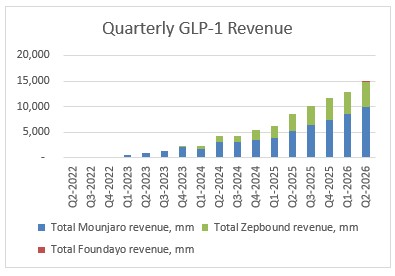
Source: Analyst’s own
What’s fascinating about that success is the unusual way the drug has grown. In the US, most patients access drugs through their insurer. But with over 100 million eligible patients and a price at launch of over US$1,000, this is an expensive problem for insurers. So, they either didn’t cover it or made access very difficult.
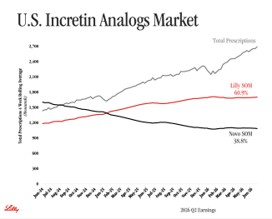
Eli Lilly responded by cutting out the middleman, launching a direct-to-consumer programme that’s fundamentally disrupting the US healthcare system. Despite being second to market behind Novo Nordisk, Lilly now dominates because of how it responded to the way the market was developing.
Source: Eli Lilly
Management was also quick to read the room in terms of the political landscape. It was one of the first to announce a Most Favoured Nation agreement with the Trump administration. That meant giving concessions on pricing. But, in return, the company gained access to the Medicare market – a pool of 30 million senior patients who have historically not had access to obesity drugs.
The company’s ability to manage pricing and access to drive volume growth is a key part of Milford’s investment thesis.
What’s next? The inevitable cliff.
The success of GLP-1s creates a monumental revenue hole when tirzepatide goes off patent in the mid-2030s. Luckily, Lilly has time on its side, and an innovation-led culture that is already driving efforts to ensure it can plug the gap.
Source: Eli Lilly
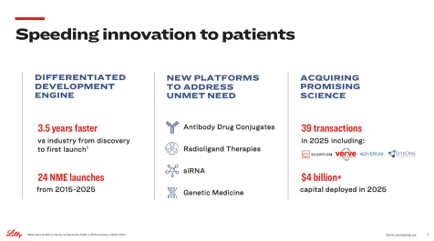
Importantly, Lilly is taking a diversified approach to building its pipeline. That includes looking at a variety of disease areas and drug modalities. It also means combining internal R&D with external business development, and Lilly has already spent more than $15 billion on acquisitions this year, building on the $4b+ spent last year.
LillyPod: AI drug discovery
AI could play an important role in addressing the cliff. In 2026 the company launched the industry’s most powerful supercomputer in partnership with Nvidia. The platform, known as LillyPod, allows Lilly to train proprietary models generated from over a billion dollars’ worth of internal research.
Perhaps more importantly, some of those models will be made available to a collaborative machine-learning drug discovery platform known as TuneLab. The platform gives biotech companies access to selected Lilly drug-discovery models. Lilly benefits directly from a richer data network but it also creates an ecosystem where it can potentially identify attractive assets at an early stage.
We think Eli Lilly will be an AI winner. Its AI strategy can lower the cost of drug discovery, improve the quality of pipeline assets and give Lilly a better chance of sustaining above-market growth into the future.
Outlook
In the near-term, Lilly has strong earnings momentum from both Medicare access and the launch of its oral GLP-1, Foundayo. We believe that will drive consensus upgrades and continue to support the stock, justifying holding at least a benchmark neutral weight.
We also have an eye on the long-term. To sustain its valuation, Lilly needs to demonstrate that it can grow beyond the GLP-1 franchise, and that is something we continue to evaluate. It’s too early to tell how successful its current investments will be, so monitoring progress is critical to how our investment view and position sizing develops over time.