
From Fire to Photons: The Picks and Shovels of Modern Mining
Every major industry eventually reaches an inflection point, where a centuries-old process is replaced by something fundamentally better. In the exploration for gold, samples are still routinely analysed using fire assay – a process involving furnaces, toxic chemicals and turnaround times measured in hours or days.
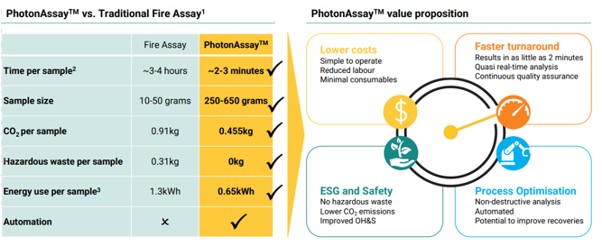
We believe the mining industry is approaching its own “fax to email” moment. Chrysos’ PhotonAssay technology replaces traditional fire assay with high-energy X-rays, delivering faster, safer and more accurate results while reducing labour requirements, energy consumption and hazardous waste.
While the technology may appear transformative, it is far from new, having been developed by Commonwealth Scientific and Industrial Research Organisation (CSIRO) researchers in Australia more than 15 years ago. As laboratories and miners increasingly prioritise productivity, faster turnaround times and stronger ESG outcomes, PhotonAssay has the potential to become the industry’s new standard, offering a long runway for adoption, as one of mining’s last major analogue processes is modernised.
As ore bodies extend to greater depths and become increasingly complex, every exploration hole, grade-control decision and gold pour relies on accurate, timely assays – making any step-change in assay technology genuinely disruptive. And gold miners, enjoying high gold prices, have every incentive to drill more, and assay more.
Source: Chrysos Prospectus, April 2022
A long deployment runway
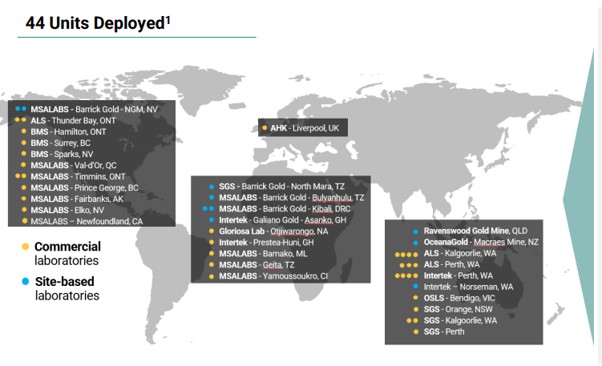
The size of the opportunity is significant. Chrysos currently has 45 units deployed and 78 contracted compared to an addressable opportunity of >600 across commercial laboratories and mine sites. The geographical expansion underway supports that view: recent milestones include a master services agreement with Newmont, the world’s largest gold miner, direct-to-mine deployments with the likes of Allied Gold, and a first until heading to Chile – Chrysos’ entry into Latin America, and its fifth continent.
Importantly, the laboratory channel does much of the selling. When ALS or Bureau Veritas installs a PhotonAssay unit and offers the service to its mining clients, adoption spreads through the industry without Chrysos funding a large salesforce. Each new region seeded with a unit becomes a live demonstration to every miner in the district, of a cleaner, faster alternative to fire assay.
Mining has never been an early adopter of new technology, particularly when it sits at the heart of mine planning and resource estimation. This conservatism has weighed on PhotoAssay’s commercial rollout and has been a key criticism of the investment case. However, the recent acceleration in contract wins suggests the adoption curve may be steepening. After securing just one new unit in FY24, Chrysos has contracted 19 units year-to-date, including five lease agreements over the past two months – the strongest performance in four years. As more laboratories adopt the technology and demonstrate its benefits, we believe this should lower barriers for future customers and create a virtuous cycle of adoption.
Source: Chrysos, May 2026
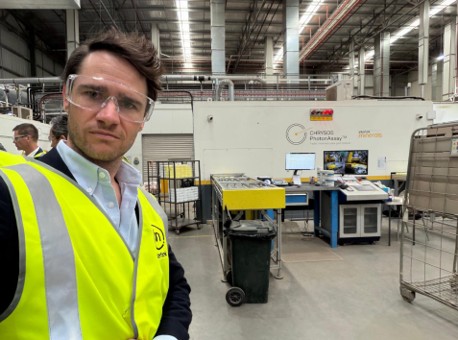
Source: Intertek analysis lab in Perth, during my site visit in May 2026.
A razor-and-blades model with recurring revenue
What we find most attractive is not just the technology, but the business model. Chrysos does not sell its machines. It leases them to the world’s major laboratory groups, including ALS and Bureau Veritas, and increasingly direct to mine sites. Each lease carries a minimum monthly payment, giving Chrysos a contracted, recurring revenue floor, with additional charges earned on every sample processed above the included threshold. As gold activity rises, so does Chrysos’ revenue, with no additional selling effort required.
What are we watching?
No investment is without risk, and Chrysos carries a few that are worth being upfront about.
The first is capital intensity. Because Chrysos retains ownership of its units, every deployment sits on its own balance sheet, and the company remains free cash flow negative – an outflow of around $20m in the first half after $30m of capital expenditure. A $200m syndicated debt facility now funds the manufacturing ramp, which is sensible at this stage of the company’s life, but it means the equity story depends on units continuing to deploy on schedule and mature to attractive returns. Deployment timing has occasionally slipped in the past, and the market has published the shares when it has.
The second is gold cyclicality. Minimum monthly payments provide a revenue floor, but the additional assay charges that drive further upside are tied to industry activity. Today’s very strong gold price is a powerful tailwind for exploration budgets and sample volumes; a sustained downturn would work in reverse.
Finally, valuation. The quality of the model is no secret, and the shares have at times priced in flawless execution. We believe the current valuation for Chrysos at 12x FY28e EBITDA (Earnings Before Interest, Taxes, Depreciation, and Amortisation) is undemanding for the category killer-potential of the product. However, as with all high-growth technology businesses, we continually assess what the share price implies against what the company can realistically deliver.
Outlook
Chrysos is that rare opportunity: an Australian home-grown, deep-technology business with a globally defensible product, a recurring revenue model, and a decade-long deployment runway in front of it. The first half of FY26 demonstrated the operating leverage we have been waiting to see, with margins expanding sharply as the fleet matures, and record utilisation confirming that customers are embedding PhotonAssay ever deeper into their operations.
We expect the path to remain uneven – deployment schedules, capital needs and the gold cycle will all inject volatility – and we manage our position size accordingly.