When you see headlines about markets at “record highs”, you might wonder: why don’t my investment funds reflect that?
It’s a fair question. But it’s worth asking what you’re actually comparing against – because that might change how you feel about it entirely.
What “the market” really means right now
This year, the US market has indeed reached record highs. But it’s important to remember that it is just one market, and not all markets move in the same way at the same time.
Other markets – the UK, Australia and New Zealand, for example – have experienced different return patterns over the same period. Different investments move in different ways, all the time. An actively managed diversified investment fund combines a variety of assets to help navigate that constant movement in pursuit of consistent long-term returns.
Also, it pays to look a little deeper. When headlines say the US market is at record highs, that usually refers to indices such as the S&P 500 or the Nasdaq. They are talking about a single market, and one that is dominated by a relatively small group of companies.
Those market index numbers are less straightforward than they look.
The ten largest stocks in the S&P 500 now account for more than 37% of the entire index. In 2025, just seven companies delivered nearly half its total return. In 2026, almost every stock driving the index higher is connected to a single theme: artificial intelligence.
When someone in the news says “the market is up”, they’re often using shorthand for something much narrower. Today, that may mean a small group of very large technology companies is up. In the past, it has been different sectors and different groups of companies driving returns.
That’s an important distinction – because comparing a diversified fund or portfolio to that isn’t a like-for-like comparison.
Why the gap is a feature, not a flaw
A diversified approach – often delivered through an investment or KiwiSaver fund – is designed to avoid depending too heavily on any single company, sector, or trend. When gains are concentrated among companies benefiting from a narrow theme, as they currently are with AI, that diversification may not keep pace with headline indices. That’s not a sign something is wrong. It’s how these investments are designed to work.
When concentrated markets turn – and historically, they have – diversified portfolios are less reliant on the same concentrated group of stocks. They’re not riding on the same concentrated small group of stocks.
At Milford, our investment approach is built around managing risk through full market cycles. The trade-off is that there can be periods where returns look lacklustre against the highest performing investment sub-sector of the day, such as a surging index. But our focus isn’t on replicating the returns of a single index, market or sector, along with the associated concentration risk. It’s on delivering strong, risk-managed long-term outcomes for our clients.
The best question to ask yourself
Rather than measuring your investment against an index it was never built to track – or a fund designed to mirror one, such as a passive ETF – a better question is simpler:
“Am I still on track?”
An investment fund returning less than a market index during a period of concentrated gains may feel disappointing in isolation. But if it’s meeting its objectives and helping you achieve your long-term goals – and taking less risk along the way – that’s not underperformance. That’s the strategy doing its job.
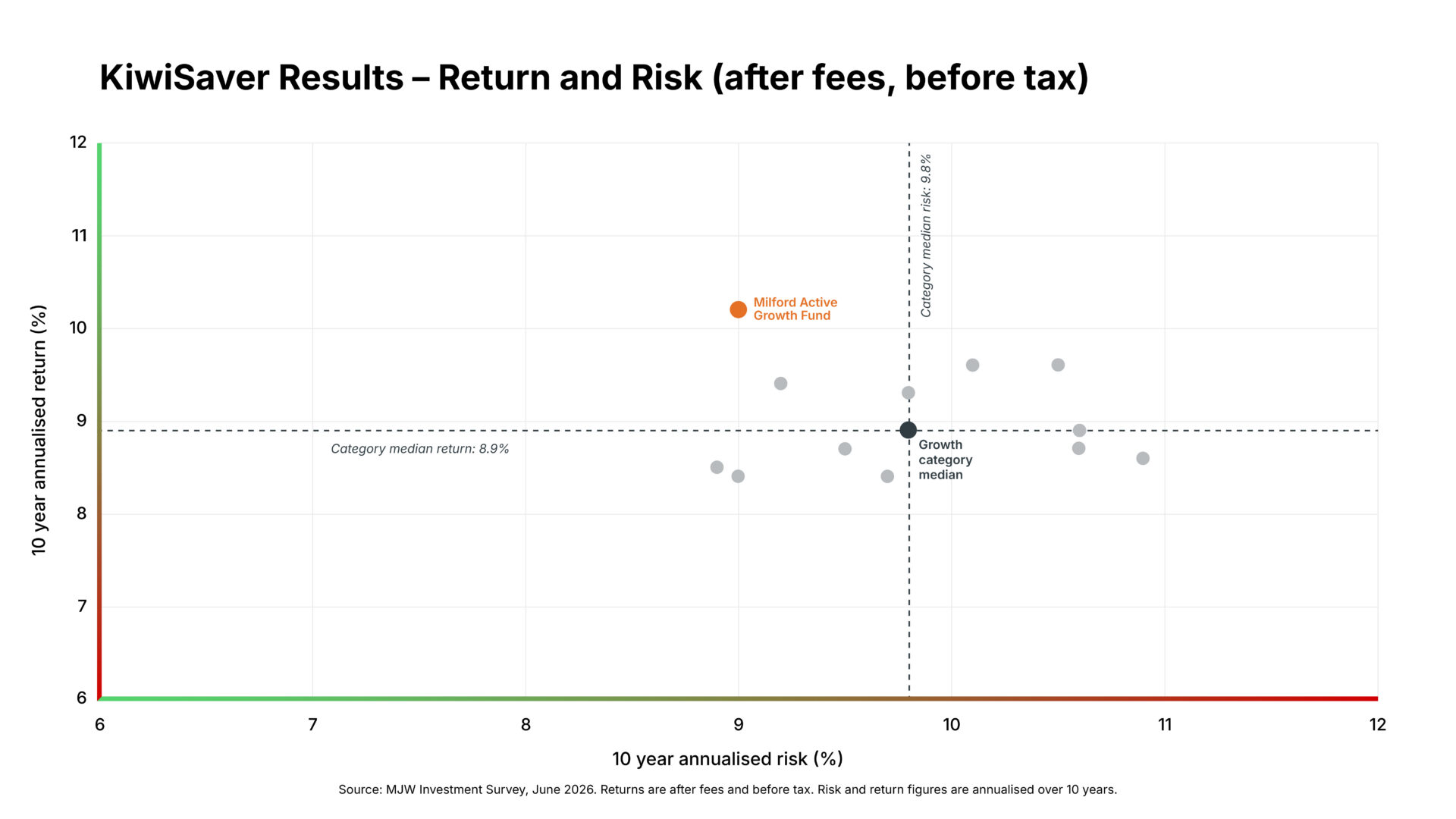
Instead of asking “did I beat the market this quarter?”, you could ask:
- Am I still on track to retire when and how I want?
- Am I taking the right level of risk to get there?
- Can I stay invested when markets move?
Investments should be measured over a timeframe that matches your horizon – usually years, rarely months. Have your long-term goals changed?
Short-term results can be noisy. They can make a well-constructed portfolio or fund look like it’s falling behind, when it’s doing exactly what it was built to do.
It’s tempting to look at a single company like Nvidia and wonder why your portfolio or fund didn’t just hold that. But a single stock can deliver spectacular gains – and equally sharp falls when conditions change. A diversified portfolio is typically designed for something different: to achieve its investment objectives through a risk-managed approach over its recommended timeframe.
And it’s easy to underestimate what’s happening beneath the surface. Active portfolio management involves ongoing decisions, including taking profits as assets rise. Those gains are realised gradually – even if they’re not always obvious in a single performance snapshot.
What this means for you
If your goals and circumstances haven’t changed, it’s worth asking whether the gap between market headlines and your investment actually calls for action. Often, it simply reflects the difference between a concentrated market and a diversified approach – and that difference is often most visible in the short term.
The next time a market hits a new high and your investment balance doesn’t seem to reflect it, the urge to react is understandable. But the better move might be to ask yourself again: am I on track? Have my goals changed? If the answers are yes and no, then what you’re seeing isn’t a problem to fix – it’s part of how investing works.
Check out our Relative Performance Frequently Asked Questions page for more info.
Disclaimer: This article is intended to provide general information only. It does not take into account your investment needs or personal circumstances. It is not intended to be viewed as investment or financial advice. Should you require financial advice you should always speak to a Financial Adviser. Past performance is not a guarantee of future performance. Investment involves risk and returns can be negative as well as positive.