If you’ve looked at your KiwiSaver account over recent months and felt uneasy, you’re not alone. Short timeframes can be a noisy guide to long‑term progress.
So if you’re focused on the past year’s result – or even the past three – and you’re not planning to access your KiwiSaver account in the next few years, you’re probably looking at the wrong number.
There’s a reason investment research providers look further out than shorter cycles, and it’s very simple: for long-term investments it is long-term results that really matter.
Many KiwiSaver investors are in it for decades, not years. A long‑term horizon gives your money time to compound and, with regular contributions, allows dollar‑cost averaging to work through periods of market volatility – reducing the impact of short‑term swings and the risk of reacting to short‑term market events at the expense of higher long‑term returns.
Why the 10-year return can be the number to focus on
The most meaningful measure is usually the longest one available. With KiwiSaver fund reporting, that often means the 10-year per annum return.
The Morningstar KiwiSaver 360 Survey for the March Quarter 2026 confirmed Milford’s Conservative, Balanced and Growth KiwiSaver Funds have delivered the highest returns over the past 10 years in their respective categories.
But the results also showed Milford did not lead the table over the shorter periods. Our investment approach is built around managing risk through full market cycles to balance risk and reward, and a one- or three-year window usually doesn’t capture a full market cycle. The trade‑off for this risk‑managed approach can be short periods of underperformance relative to the broader market.
But our focus is not on replicating index returns; instead, it is on delivering strong outcomes for investors over an appropriate long‑term horizon.
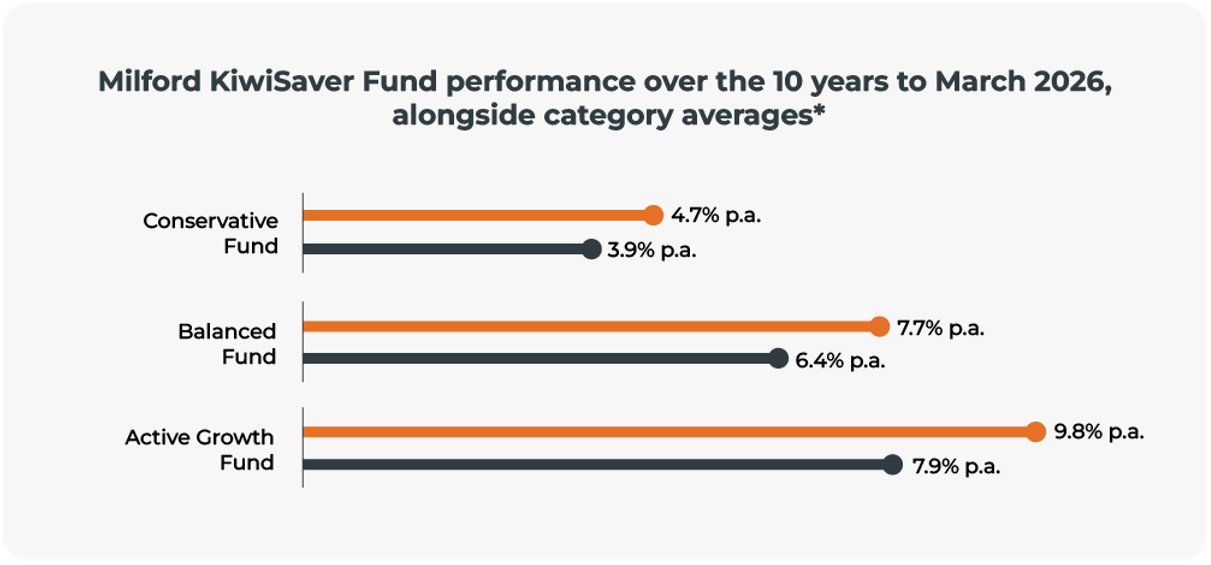
* Milford KiwiSaver Conservative Fund ranked 1st out of 14 funds in the Conservative category, Milford KiwiSaver Balanced Fund ranked 1st out of 18 in the Balanced category, and Milford KiwiSaver Active Growth Fund ranked 1st out of 17 in the Growth category for 10-year returns as at 31.03.2026 in the Morningstar KiwiSaver 360 Survey (March Quarter 2026), which is published here.
What this means for you
If your KiwiSaver account is a long-term investment, it deserves to be measured like one. That’s why the number worth focusing on may well be the 10-year return for your particular KiwiSaver fund.
When you first made the decision to join Milford, you would probably have selected your Fund based on your investment timeline and your level of comfort with market movements. If neither of those considerations has changed, continuing with your current Fund may still be appropriate. If either has changed over recent years, or if you want to make sure your plan still aligns with your financial goals, give us a call.
Disclaimer: This article is intended to provide general information only. It does not take into account your investment needs or personal circumstances. It is not intended to be viewed as investment or financial advice. Should you require financial advice you should always speak to a Financial Adviser. Past performance is not a guarantee of future performance. Investment involves risk and returns can be negative as well as positive. Milford Funds Limited is the issuer of the Milford KiwiSaver Plan. Please read the Milford KiwiSaver Plan Product Disclosure Statement at milfordasset.com. For more information on our financial advice services, please visit https://milfordasset.com/digital-advice-tools
© 2026 Morningstar. All Rights Reserved. The information contained in the report: (1) is proprietary to Morningstar and/or its affiliates or content providers; (2) may not be copied, adapted or distributed; (3) is not warranted to be accurate, complete or timely; and (4) does not constitute advice of any kind, whether investment, tax, legal or otherwise; and (5) has been prepared for New Zealand wholesale clients of Morningstar Research Ltd, and is not intended for New Zealand retail clients. Neither Morningstar nor its content providers are responsible for any damages arising from the use and distribution of this information.